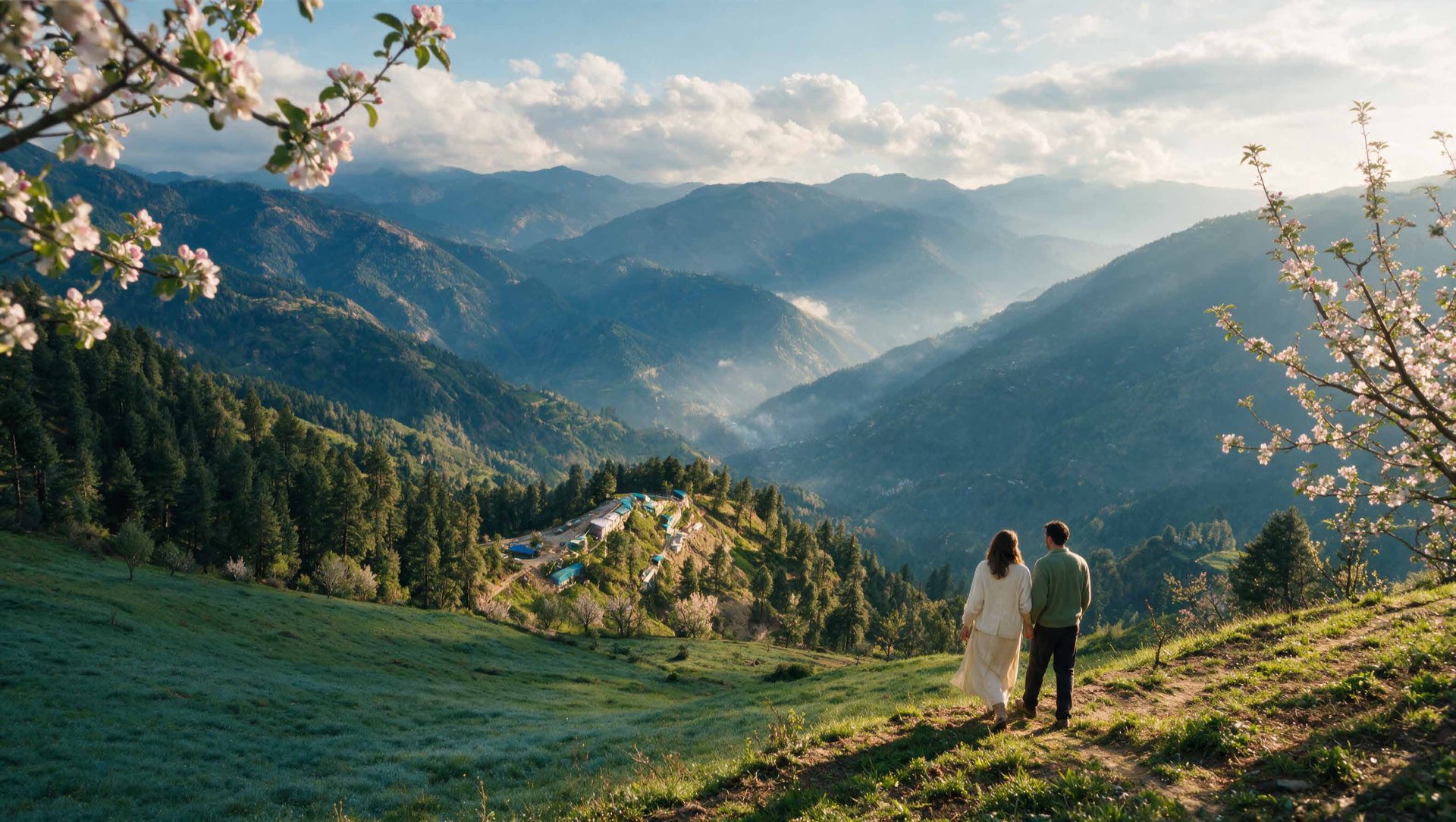
The pioneer of branded land in India: institutional governance, technology and trust applied to the country's oldest asset class.
Not every expensive address is irreplaceable. True irreplaceability rests on four things, and what we are going to offer earns all four.
A place that cannot be recreated: so unique that it is only one of a kind.
It cannot simply be bought, cleared and built on. Legal, ecological and regulatory barriers keep supply permanently limited.
An idea the market has never seen before.
A product impossible to replicate anywhere else.
Some places are simply too rare to ever be found again.
The hills are no longer an escape. They are becoming the next address of choice.
Hard to acquire. Acquiring land in mountain terrain is constrained by complex legal approvals, forest regulations, and zoning restrictions.
Complex to build. Steep terrain demands specialised engineering, access and slope management.
Large areas are protected. Forests, sanctuaries and watersheds remain off-limits to development.
Buildable land is finite. The right combination of altitude, ecology, access and terrain is exceptionally rare.
Some landscapes are nature's rarities, shaped long before we arrive.
Long before any law protected it, the world had discovered the rare gem called Mashobra.
At 8,600 feet, Mashobra became a preferred Himalayan retreat in the late 1800s and early 1900s. Its untouched forests, crisp mountain air and sweeping landscapes drew the British Empire's highest office bearers.
Lord Kitchener built Wildflower Hall here, now home to the iconic Oberoi resort. Once the Viceroy's retreat, today the President of India's summer residence.
Lord Curzon established the nearby Naldehra Golf Course. Mashobra reminded Count Peliti so deeply of his native Italian village that he named his estate Craignano.
What came next ensured no one else ever could discover it the same way.
Once discovered, Mashobra was deliberately left only for the selected.
Section 118 restricts land acquisition by non-Himachali residents and protects agricultural land, with adjoining apple orchards, making ownership itself an exceptional privilege.
The HP Town & Country Planning Act and NGT regulations tightly restrict construction, height and future development.
Steep terrain, seismic regulations and hill planning norms mean only a small portion of land can ever be developed.
Large parcels cannot be freely acquired or combined. No development is permitted in the reserve forests that adjoin the Mashobra ridge.
Delhi
Before there were homes, there were forests. Before there were roads, there were streams. Before there was architecture, there was a landscape quietly creating the conditions for a richer way of life. Today, those conditions remain remarkably intact in Mashobra.
Nature flourishes and life follows. A thriving forest is measured not by the trees that stand tall, but by the life they quietly sustain. From the iridescent Himalayan Monal and elusive Himalayan Goral to Barking Deer, Flying Squirrels and hundreds of native pollinators, Mashobra remains a refuge for species that can exist only where ecosystems remain truly intact.
Their presence is nature's own assurance that these mountains are alive, balanced and enduring. The healthier the ecosystem, the richer the life it enables.
The Lex Weber cap prohibits any new construction of second homes. Limited resale permitted.
Demolition restrictions, federal boundaries and the presence of many ski resorts restrict and choke the supply of new land and new construction.
Extremely limited supply due to the HP Tenancy Act, Section 118, protected forests and planning regulations.
Alpine destinations have become a Billionaire's favourite and a global benchmark for clean air, protected forests, low-density zones, moderate altitude and everyday movement.


Time spent at altitude isn't simply a holiday. It's a physiological reset. None of this requires a gym, a diet, or an intervention: the environment itself is doing the work.
Within days, red blood cell production increases: the same adaptation elite athletes train for. Oxygen moves through the body more efficiently.
Resting heart rate steadies as the cardiovascular system settles into its new baseline.
Mountain trails do what flat ground can't. Every incline becomes quiet cardiovascular training, without needing to try.
Time among trees lowers cortisol and sharpens focus, letting the nervous system finally stand down. Food grown close to the table asks less of digestion and gives more back.
Some visions begin where the familiar no longer feels enough.
Mashobra is rare: pure in its air, abundant in its forests, alive through every season. It gives us the setting for a healthier, fuller way of life.
Longevity is about living longer and staying better for longer: the science of extending healthspan, the years we remain energetic, resilient and mentally sharp, not simply the years we live.


That's Delhi, every single day: 20 decibels past what's legally supposed to be safe.
That's the green space per person in parts of Delhi: a fifth of the WHO's own minimum.
That's what the air in Delhi already costs you.
That is Life Beyond the Edge.
Designed as a single, integrated ecosystem, one where every element works together to: reconnect you with nature | free your attention | strengthen your wellbeing.
Reconnect with nature through rare landscapes that broaden perspective and awaken a deeper sense of place.
Let intuitive hospitality take care of the everyday, so your time and attention return to what matters most.
Strengthen body and mind through science-led wellbeing, designed to cultivate lasting vitality and resilience.
Some things can only exist once, because they belong to one place alone.

Benoy is an award-winning international firm of architects, master planners, and designers founded in the UK in 1947. They specialize in large-scale commercial, retail, and mixed-use destinations globally.

Studio Built Environment (SBE) is an award-winning architecture and research practice led by Siddharth Mahim Bansal, with a deep body of work across the Himalayas. Rooted in climate, contours and local materiality, SBE creates contemporary architecture that feels inherently at home in its landscape.
SBE has collaborated with global consultants to introduce advanced engineering technologies to Himalayan architecture, designed to mitigate landslide risks and enhance earthquake resilience.

Our engineering systems have been rigorously reviewed and validated by IIT Roorkee for structural safety, seismic resilience and site stability.
Not one firm's opinion, but engineering cross-validated by global specialists and IIT Roorkee: bringing world-class rigour to safety in the Himalayas.